LLM движок на llama.cpp
The Challenge
Can you build a production-ready inference harness for large language models in a single day + night? That was my goal — to create a C++ tool that demonstrates deep expertise with llama.cpp and GGML, capable of running on CPU, CUDA, or Metal with precise performance metrics.
The result is a clean, well-documented inference engine that:
- Loads any GGUF model
- Offloads transformer layers to GPU with fine-grained control
- Measures TTFT, tokens/second, and peak memory usage
- Runs on Windows, Linux, and macOS
What I Built
A C++17 application that wraps llama.cpp with:
- Runtime backend selection (CPU/CUDA/Metal via
--backend) - Precise GPU layer offloading control (
--gpu-layers N) - Production metrics (TTFT, Prefill/Generation t/s, peak memory)
- Automatic benchmark suite comparing different configurations
The code is clean, follows modern CMake practices, and is ready for integration into production systems.
Key Technical Deep Dives
1. Navigating llama.cpp’s Evolving API
Working with llama.cpp taught me that the library is under active development. I navigated recent breaking changes:
| API Change | Implementation |
|---|---|
llama_sampling_context → llama_sampler_chain | Adopted the new chain-of-samplers pattern |
Vocabulary separation (llama_vocab) | Used llama_model_vocab() for tokenizer access |
llama_tokenize(ctx) → llama_tokenize(vocab) | Switched to vocabulary-based tokenization |
2. GPU Optimization: Layer Offloading
The most critical optimization is controlling how many transformer layers run on GPU:
llama_model_params model_params = llama_model_default_params();
model_params.n_gpu_layers = config.n_gpu_layers;  // Key parameter!
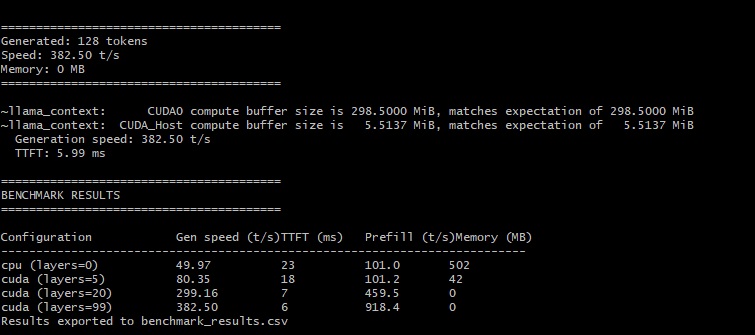
Example benchmark on NVIDIA RTX 5060 8GB vs AMD Ryzen 7 7800X3D 8-Core with qwen2-0_5b-instruct-q8_0:
| Configuration | Gen Speed (t/s) | TTFT (ms) | Prefill (t/s) | Memory (MB) |
|---|---|---|---|---|
| CPU (baseline) | 49.97 | 23 | 101.0 | 502 |
| CUDA (5 layers) | 80.35 | 18 | 101.2 | 42 |
| CUDA (20 layers) | 299.16 | 7 | 459.5 | 0 |
| CUDA (99 = all layers) | 382.50 | 6 | 918.4 | 0 |
3. Precise Performance Measurement
For CUDA, I used cudaEvent for GPU-accurate timing:
cudaEvent_t start, stop;
cudaEventRecord(start);
llama_decode(ctx_, batch);
cudaEventRecord(stop);
float elapsed_ms;
cudaEventElapsedTime(&elapsed_ms, start, stop);
This avoids CPU-GPU synchronization overhead and gives true hardware timing.
4. Cross-Platform Memory Tracking
Implemented memory usage tracking for Windows (GetProcessMemoryInfo), Linux (getrusage), and macOS to measure peak consumption during inference.
Challenges Overcome
| Challenge | Solution |
|---|---|
llama_tokenize returning -2 | Switched to one-pass tokenization with fixed buffer |
Incomplete llama_model type error | Included llama-model.h or used public API |
| CUDA not finding Visual Studio | Used Developer Command Prompt |
| Missing DLLs on Windows | Copied llama.dll, ggml-*.dll to executable directory |
Key Takeaways
Building this inference harness taught me:
- Follow upstream changes —
llama.cppevolves rapidly; always check the latest API - Understand GGML architecture — backends, memory management, tensor operations
- Measure what matters — TTFT matters more than raw throughput for interactive apps
- Write portable code — CPU/CUDA/Metal with runtime selection
The Code
The full project is available on GitHub:
🔗 github.com/oldscripter/llama-inference-harness
git clone https://github.com/oldscripter/llama-inference-harness.git
cd llama-inference-harness
git submodule update --init --recursive

mkdir build && cd build
cmake .. -DGGML_CUDA=ON
cmake --build . --config Release -j4

./llama_harness --model model.gguf --backend cuda --gpu-layers 99
What’s Next?
This project is a foundation. Future improvements could include:
- Continuous batching — Higher throughput for multiple concurrent requests
- Speculative decoding — Faster generation with draft models
- Quantization-aware inference — Better accuracy at low bit depths
- WebAssembly build — Browser-based inference
Conclusion
Building a production-ready inference engine for LLMs is challenging but achievable. The combination of llama.cpp’s excellent GGML library, modern C++, and careful performance engineering makes on-device AI a reality.
I’m excited to see what others build with this codebase and to continue exploring the frontier of efficient LLM inference.
Questions? Comments? Feel free to open an issue on GitHub or reach out.
📖 Читать эту статью на Английском